League of Lonely War Women (English Language Draft Copy)
Dublin Core
Title
League of Lonely War Women (English Language Draft Copy)
Subject
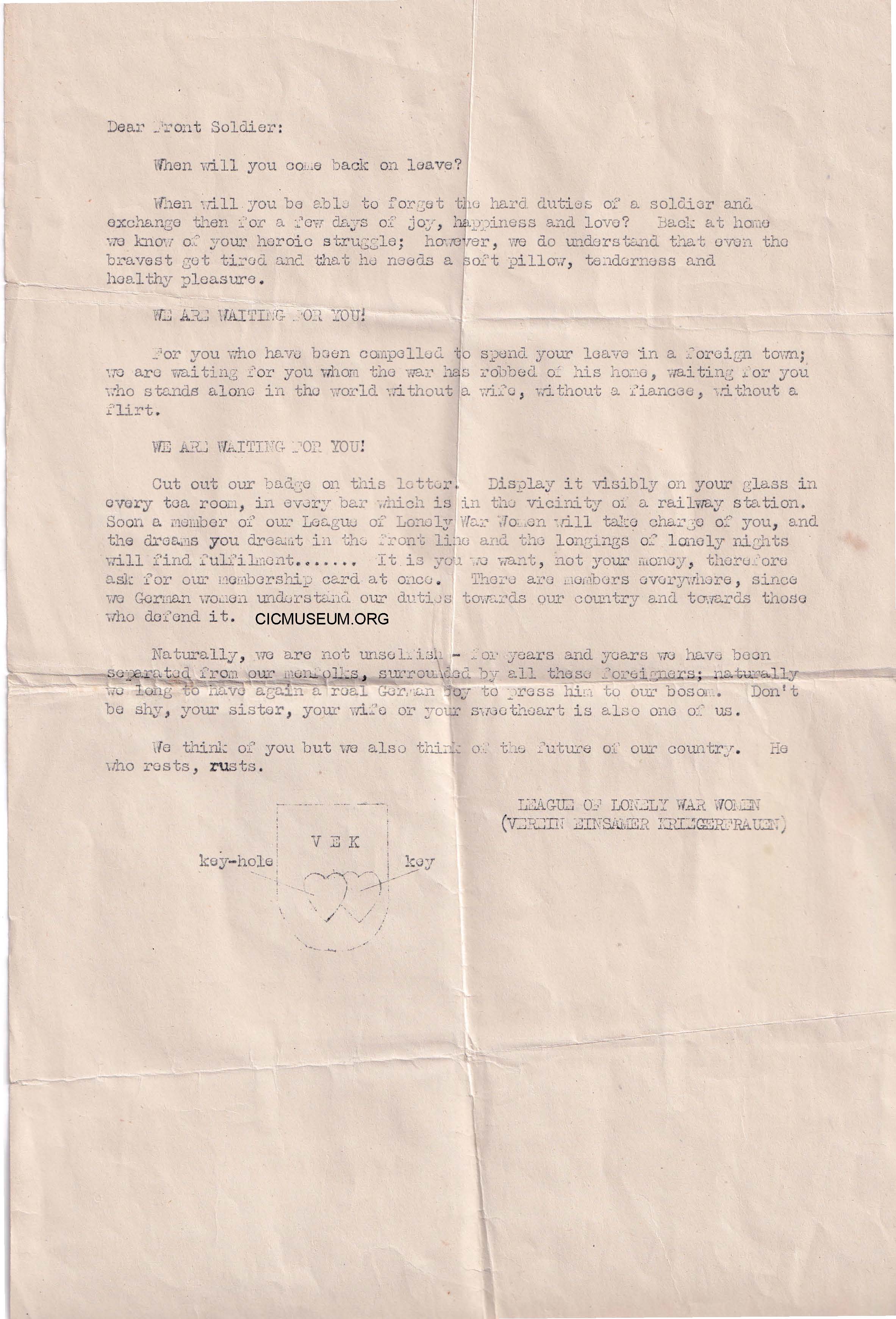
This appears to be an English language draft copy of Corporal Barbara Lauwers League of Lonely War Women propaganda leaflet for German soldiers. Barbara Lauwers Podoski (born Božena Hauserová on April 22 , 1914 , in Brno , Austria-Hungary ; died August 16, 2009 , in Washington, D.C. , United States ) was a Czechoslovak - American agent. During World War II, she worked for the U.S. intelligence agency, the Office of Strategic Services (OSS). Her propaganda operations led hundreds of soldiers to defect to the Allied side . Barbara Lauwers was born Božena Hauserová in Brno , which at that time belonged to Austria-Hungary and from 1918 to Czechoslovakia . She studied law at the University of Paris and Masaryk University in her birthplace. She earned her doctorate in law from the latter and subsequently worked as a lawyer. In 1939, when Czechoslovakia was occupied by Nazi Germany , she married the American Charles Lauwers in Zlín and emigrated with him to the Belgian Congo , where she worked for the shoe manufacturer Bata . Two years later, the couple emigrated to New York .
When Charles Lauwers volunteered for the U.S. Army in 1941, following the attack on Pearl Harbor and the United States' entry into World War II , Barbara Lauwers, as she now called herself, moved to Washington, D.C. , and began working in the press office of the Czechoslovakian embassy. As a ghostwriter , she wrote a book for each pair of Czechoslovakian colonels stationed there . On June 1, 1943, the day she received U.S. citizenship , she joined the Women's Army Corps . Because of her language skills—she was fluent in English, French, German, Czech, and Slovak—she was selected for the Office of Strategic Services (OSS), which had been established a year earlier. After an initial posting in Washington, she was transferred to Algiers in North Africa in early 1944 and finally, in light of the Italian campaign , to Rome , to the Department of Morale Operations . There, she conducted interrogations of prisoners of war , among other things, to recruit them as deserters for propaganda purposes . During one such interrogation , Private Lauwers learned from a captured sergeant that the Wehrmacht was using primarily Czechs and Slovaks for "dirty work" on the Italian front. This gave Lauwers an idea, but he subsequently felt her wrath. When he spoke disparagingly about US President Franklin D. Roosevelt , Lauwers lost her temper and punched him in the nose. She borrowed both a Czech and a Slovak typewriter from the Vatican and prepared a leaflet in both languages to encourage enemy soldiers to desert, claiming they were being used by the enemy. The contents of the leaflets were also broadcast on the BBC radio. Within a week, hundreds of Czech and Slovak soldiers had defected to the Allied side; at least 600 of them had the leaflets designed by Lauwers with them.
Lauwers' main focus then shifted to producing so-called black propaganda to demoralize and disinform the Germans. This particular form of psychological warfare aimed to convince the enemy that, for example, the leaflets were their own creations. As part of Operation Sauerkraut, Lauwers designed further leaflets, including one claiming that the July 20, 1944, assassination attempt on Adolf Hitler had led to a revolt within the German army. Another leaflet announced Field Marshal Albert Kesselring's resignation from all his posts, as he considered the war lost. German prisoners of war held in Italy, selected by Lauwers and persuaded to desert, distributed this propaganda behind German lines after their release. Kesselring, the German commander-in-chief in Italy, was forced by the success of the operation to publicly deny the allegations against him.
With his promotion to corporal , Lauwers was given responsibility for the next operation, the League of Lonely War Women . Leaflets were distributed among German soldiers on leave, urging them to cut out the paper heart printed on the leaflet and lean it against their glasses in public places like bars and restaurants. Members of the League of Lonely War Women, as it was dubbed in German, would then approach the soldiers so they could satisfy their own desires and the women's desires for physical intimacy. Since their husbands were away due to the war, they hoped to find temporary replacements in the soldiers on leave. This was intended to sow suspicion among the soldiers that their own wives at home were also being unfaithful.
"Of course we're also selfish – separated from our husbands for years, with all these strangers around us, we'd like to hug a real German boy again. No inhibitions: Your wife, sister, and lover is also one of ours."
– Association of Lone Warrior Women : Leaflet
Lauwers wrote the wording of the leaflet herself, using common German soldier slang to ensure a high degree of authenticity. This deception proved successful and so convincing that even the Washington Post fell for it on October 10, 1944, and reported on it. For her service with the OSS, Barbara Lauwers was awarded the Bronze Star on April 6, 1945. After the war, Lauwers spent several years in Czechoslovakia. However, she returned to the United States before the February 1948 coup and initially worked for Voice of America , the official overseas broadcaster of the United States. She also worked as a general assistant at the National Academy of Sciences in Washington. During the war, she had divorced her husband, Charles. From 1948, she worked for 20 years as a research assistant at the Library of Congress . During this time, she met Joseph Junosza Podoski, whom she married in 1954. The couple had one daughter. Upon her retirement in 1968, she returned to Austria , where she remained for nine years, working as an assistant in the Vienna office of the United Nations High Commissioner for Refugees . In 1977, she moved back to Washington. Seven years later, Joseph Podoski died. In 1999, shortly before Barbara Lauwers Podoski herself, her last partner, J.R. Coolidge, died. Lauwers Podoski succumbed to cardiovascular disease on August 16, 2009, at Veterans Affairs Hospital in Washington. Most of her work during World War II only became public in 2008 when the files from her time with the OSS were released.
When Charles Lauwers volunteered for the U.S. Army in 1941, following the attack on Pearl Harbor and the United States' entry into World War II , Barbara Lauwers, as she now called herself, moved to Washington, D.C. , and began working in the press office of the Czechoslovakian embassy. As a ghostwriter , she wrote a book for each pair of Czechoslovakian colonels stationed there . On June 1, 1943, the day she received U.S. citizenship , she joined the Women's Army Corps . Because of her language skills—she was fluent in English, French, German, Czech, and Slovak—she was selected for the Office of Strategic Services (OSS), which had been established a year earlier. After an initial posting in Washington, she was transferred to Algiers in North Africa in early 1944 and finally, in light of the Italian campaign , to Rome , to the Department of Morale Operations . There, she conducted interrogations of prisoners of war , among other things, to recruit them as deserters for propaganda purposes . During one such interrogation , Private Lauwers learned from a captured sergeant that the Wehrmacht was using primarily Czechs and Slovaks for "dirty work" on the Italian front. This gave Lauwers an idea, but he subsequently felt her wrath. When he spoke disparagingly about US President Franklin D. Roosevelt , Lauwers lost her temper and punched him in the nose. She borrowed both a Czech and a Slovak typewriter from the Vatican and prepared a leaflet in both languages to encourage enemy soldiers to desert, claiming they were being used by the enemy. The contents of the leaflets were also broadcast on the BBC radio. Within a week, hundreds of Czech and Slovak soldiers had defected to the Allied side; at least 600 of them had the leaflets designed by Lauwers with them.
Lauwers' main focus then shifted to producing so-called black propaganda to demoralize and disinform the Germans. This particular form of psychological warfare aimed to convince the enemy that, for example, the leaflets were their own creations. As part of Operation Sauerkraut, Lauwers designed further leaflets, including one claiming that the July 20, 1944, assassination attempt on Adolf Hitler had led to a revolt within the German army. Another leaflet announced Field Marshal Albert Kesselring's resignation from all his posts, as he considered the war lost. German prisoners of war held in Italy, selected by Lauwers and persuaded to desert, distributed this propaganda behind German lines after their release. Kesselring, the German commander-in-chief in Italy, was forced by the success of the operation to publicly deny the allegations against him.
With his promotion to corporal , Lauwers was given responsibility for the next operation, the League of Lonely War Women . Leaflets were distributed among German soldiers on leave, urging them to cut out the paper heart printed on the leaflet and lean it against their glasses in public places like bars and restaurants. Members of the League of Lonely War Women, as it was dubbed in German, would then approach the soldiers so they could satisfy their own desires and the women's desires for physical intimacy. Since their husbands were away due to the war, they hoped to find temporary replacements in the soldiers on leave. This was intended to sow suspicion among the soldiers that their own wives at home were also being unfaithful.
"Of course we're also selfish – separated from our husbands for years, with all these strangers around us, we'd like to hug a real German boy again. No inhibitions: Your wife, sister, and lover is also one of ours."
– Association of Lone Warrior Women : Leaflet
Lauwers wrote the wording of the leaflet herself, using common German soldier slang to ensure a high degree of authenticity. This deception proved successful and so convincing that even the Washington Post fell for it on October 10, 1944, and reported on it. For her service with the OSS, Barbara Lauwers was awarded the Bronze Star on April 6, 1945. After the war, Lauwers spent several years in Czechoslovakia. However, she returned to the United States before the February 1948 coup and initially worked for Voice of America , the official overseas broadcaster of the United States. She also worked as a general assistant at the National Academy of Sciences in Washington. During the war, she had divorced her husband, Charles. From 1948, she worked for 20 years as a research assistant at the Library of Congress . During this time, she met Joseph Junosza Podoski, whom she married in 1954. The couple had one daughter. Upon her retirement in 1968, she returned to Austria , where she remained for nine years, working as an assistant in the Vienna office of the United Nations High Commissioner for Refugees . In 1977, she moved back to Washington. Seven years later, Joseph Podoski died. In 1999, shortly before Barbara Lauwers Podoski herself, her last partner, J.R. Coolidge, died. Lauwers Podoski succumbed to cardiovascular disease on August 16, 2009, at Veterans Affairs Hospital in Washington. Most of her work during World War II only became public in 2008 when the files from her time with the OSS were released.
Source
Acquired from Stephen Wheeler Medals in London, UK. Information taken from Wikipedia.
Date
1944
Collection
Citation
“League of Lonely War Women (English Language Draft Copy),” CIC Museum, accessed September 29, 2026, https://cicmuseum.org/items/show/80.