Arbeitskarte Maria Markowa
Dublin Core
Title
Arbeitskarte Maria Markowa
Subject
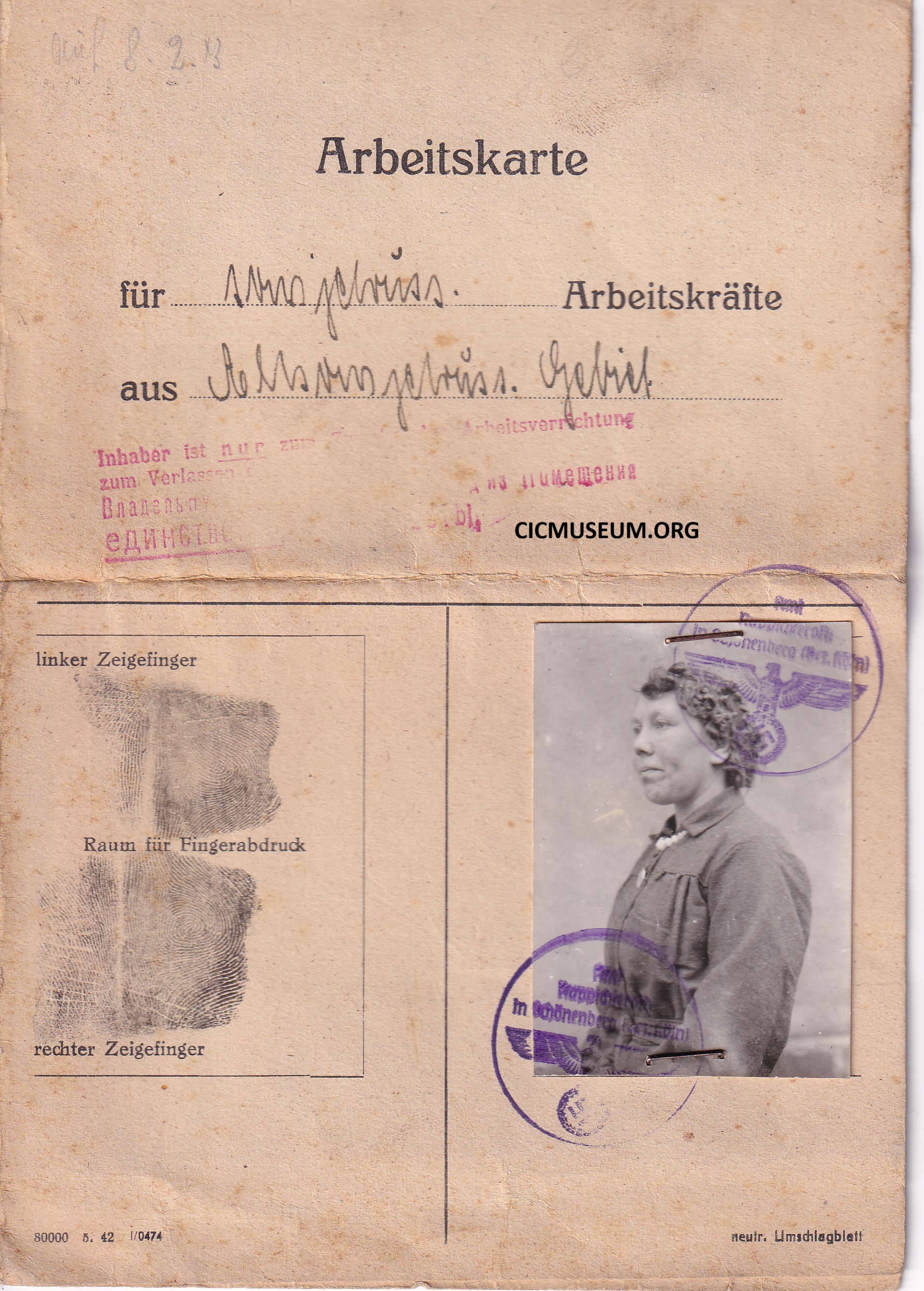
This is a worker ID card for Maria Markowa who was likely captured and taken to Hatterscheid in Western Germany near Bonn as a forced Polish agricultural worker or Zivilarbeiter.
Zivilarbeiter (civilian worker) refers primarily to ethnic Polish residents from the General Government (Nazi-occupied central Poland), used during World War II as forced laborers in the Third Reich.
The residents of occupied Poland were conscripted on the basis of the so-called Polish decrees (Polenerlasse), and were subject to discriminatory regulation.
Compared to German workers or foreign workers from neutral and German-allied countries (Gastarbeitnehmer), Polish Zivilarbeiters received lower wages and were not allowed to use public conveniences (such as public transport) or visit many public spaces and businesses (for example they were not allowed to attend German church services, visit swimming pools or restaurants); they had to work longer hours than Germans; they received smaller food rations; they were subject to a curfew; they often were denied holidays and had to work seven days a week; could not enter a marriage without permission; possess money or objects of value. Bicycles, cameras and even lighters were forbidden. They were required to wear a sign – the "Polish-P" – attached to their clothing.
In late 1939 there were about 300,000 prisoners from Poland working in Germany; By autumn of 1944 their number swelled to about 2.8 million (approximately 10% of General governement workforce). Poles from territories taken over after the German invasion of the Soviet Union and not included in the General Government (see Kresy) were treated as Ostarbeiters.
The history of Polish Zivilarbeiters dates back to October 1939, when German authorities issued a decree, which introduced mandatory work system for all residents aged 18 to 60. In December 1939, the system also covered those aged 14 to 18, with severe punishments for law breakers. The people who did not work were called by the local authorities, and sent to work in Germany. Since the Third Reich suffered from shortage of workers, as time went by also those Poles who had permanent employment, but were not regarded as necessary for the economy, were sent to Germany. Other methods were also used, such as the infamous roundups, called "łapanka" in Poland. Those who did not present a certificate of employment were automatically sent to Germany.
Most Polish Zivilarbeiters worked in agriculture, forestry, gardening, fishing, also in transport and industry. Some were employed as housekeepers. None signed any contracts, and their working hours were determined by the employers.
Zivilarbeiter (civilian worker) refers primarily to ethnic Polish residents from the General Government (Nazi-occupied central Poland), used during World War II as forced laborers in the Third Reich.
The residents of occupied Poland were conscripted on the basis of the so-called Polish decrees (Polenerlasse), and were subject to discriminatory regulation.
Compared to German workers or foreign workers from neutral and German-allied countries (Gastarbeitnehmer), Polish Zivilarbeiters received lower wages and were not allowed to use public conveniences (such as public transport) or visit many public spaces and businesses (for example they were not allowed to attend German church services, visit swimming pools or restaurants); they had to work longer hours than Germans; they received smaller food rations; they were subject to a curfew; they often were denied holidays and had to work seven days a week; could not enter a marriage without permission; possess money or objects of value. Bicycles, cameras and even lighters were forbidden. They were required to wear a sign – the "Polish-P" – attached to their clothing.
In late 1939 there were about 300,000 prisoners from Poland working in Germany; By autumn of 1944 their number swelled to about 2.8 million (approximately 10% of General governement workforce). Poles from territories taken over after the German invasion of the Soviet Union and not included in the General Government (see Kresy) were treated as Ostarbeiters.
The history of Polish Zivilarbeiters dates back to October 1939, when German authorities issued a decree, which introduced mandatory work system for all residents aged 18 to 60. In December 1939, the system also covered those aged 14 to 18, with severe punishments for law breakers. The people who did not work were called by the local authorities, and sent to work in Germany. Since the Third Reich suffered from shortage of workers, as time went by also those Poles who had permanent employment, but were not regarded as necessary for the economy, were sent to Germany. Other methods were also used, such as the infamous roundups, called "łapanka" in Poland. Those who did not present a certificate of employment were automatically sent to Germany.
Most Polish Zivilarbeiters worked in agriculture, forestry, gardening, fishing, also in transport and industry. Some were employed as housekeepers. None signed any contracts, and their working hours were determined by the employers.
Description
The front cover of the ID booklet features a photo along with fingerprints and a red stamp that says in both English and Russian:
"The holder is authorized to leave the accommodation only for the purpose of going to work."
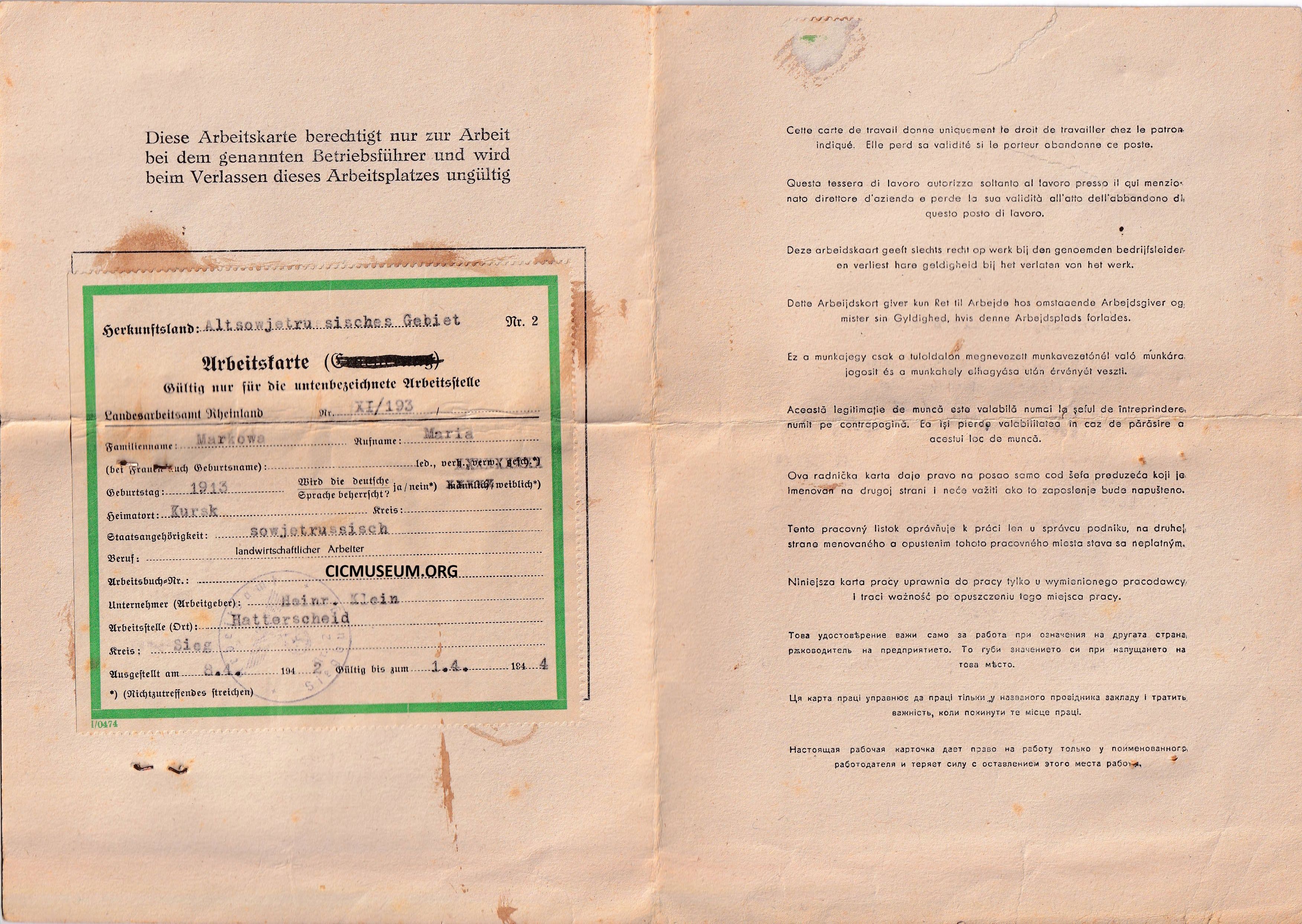
Translation of the internal pages
Upper-left notice
Diese Arbeitskarte berechtigt nur zur Arbeit bei dem genannten Betriebsführer und wird beim Verlassen dieses Arbeitsplatzes ungültig.
Translation:
This work card authorizes the holder to work only for the named employer/company manager and becomes invalid upon leaving this workplace.
“Betriebsführer” literally means “head/manager of the enterprise.” In this historical context, “employer” is probably the clearest English rendering.
Work card
Herkunftsland:
Altsowjetrussisches Gebiet
Country/territory of origin: Former Soviet Russian territory
The historically specific German designation “Altsowjetrussisches Gebiet” is an official Nazi-era administrative category associated with “Ostarbeiter” (Eastern workers), and did not simply mean “Russia” in the modern geographic sense.
Heading
Arbeitskarte
Work Card
The word in parentheses immediately after Arbeitskarte has been heavily crossed out/obliterated.
Gültig nur für die unterbezeichnete Arbeitsstelle
Valid only for the workplace specified below
Issuing authority
Landesarbeitsamt Rheinland
Rhineland Regional Labour Office
Nr. XI/193
No. XI/193
The final portion of the number is somewhat obscured, so XI/193 is my best reading.
Personal information
Familienname
Markowa
Family name / surname: Markowa
Rufname
Maria
Given name: Maria
(bei Frauen auch Geburtsname)
(for women, also maiden name)
The space for the maiden/birth name appears blank.
led., verh., verw., gesch.
These are abbreviations for:
led. = ledig — single
verh. = verheiratet — married
verw. = verwitwet — widowed
gesch. = geschieden — divorced
With the X's marking off the other options it appears that she is labeled as single.
Geburtstag
1913
Date/year of birth: 1913
Only the year is entered on this card.
Wird die deutsche Sprache beherrscht? ja/nein*
Does she speak German? Yes/no*
The marking is not sufficiently clear to determine whether yes or no was selected.
The asterisk refers to the instruction at the bottom:
* (Nichtzutreffendes streichen)
* (Strike out what does not apply)
männlich / weiblich*
male / female*
The form has the alternatives male/female. The visible marking appears to indicate female.
Heimatort
Kursk
Place of origin/home town: Kursk
This is an important detail: Kursk is quite legible.
Kreis
The field appears to be blank on this side of the document.
Staatsangehörigkeit
sowjetrussisch
Nationality/citizenship: Soviet Russian
This is the wording actually entered on the document.
Beruf
landwirtschaftlicher Arbeiter
Occupation: agricultural worker
Literally, “agricultural laborer/worker.”
Arbeitsbuch-Nr.
Work-book No.: [blank]
No number appears to have been entered.
Employment information
Unternehmer (Arbeitgeber)
Heinr. Klein
Employer: Heinr. Klein
“Heinr.” is the conventional German abbreviation for Heinrich.
Arbeitsstelle (Ort)
Hatterscheid
Workplace (location): Hatterscheid
Kreis
Sieg...
The entry appears to read Sieg..., and is very likely Siegkreis, the administrative district (Kreis) in which Hatterscheid was located at the time.
District: Siegkreis [apparently]
Dates
Ausgestellt am
The handwriting appears to read:
8.4.1942
Issued on: 8 April 1942
Gültig bis zum
14.4.1944
Valid until: 14 April 1944
Right-hand page
The right-hand page repeats the same warning in several languages. The German version on the facing page is the controlling text:
Diese Arbeitskarte berechtigt nur zur Arbeit bei dem genannten Betriebsführer und wird beim Verlassen dieses Arbeitsplatzes ungültig.
English:
This work card authorizes the holder to work only for the named employer/company manager and becomes invalid upon leaving this workplace.
The multilingual versions say essentially the same thing:
French: This work card grants the right to work only for the indicated employer and loses its validity if the holder leaves this position/workplace.
Italian: This work card authorizes work only with the named company director/employer and loses its validity upon leaving this workplace.
Dutch: This work card gives the right to work only for the named company manager/employer and loses its validity upon leaving the work.
Danish: This work card gives the right to work only for the named employer and loses its validity if this workplace is left.
Hungarian: This work card authorizes work only for the named employer and becomes invalid upon leaving the workplace.
Romanian: This work permit/card is valid only for the named employer and loses its validity if the workplace is left.
Serbo-Croatian: This worker's card gives the right to work only for the employer named on the other side and ceases to be valid upon leaving the workplace.
Czech: This work card authorizes work only for the named employer and becomes invalid upon leaving this workplace.
Polish: This work card authorizes work only for the employer named on the other side and loses its validity upon leaving the workplace.
Ukrainian: This work card authorizes work only for the employer named on the other side and loses its validity upon leaving the workplace.
Russian: This work card authorizes work only for the named employer and loses its validity upon leaving the workplace.
The multilingual repetition is therefore not additional personal information; it is the same restriction printed for foreign workers in multiple languages.
The back reads:
Space for entries by the Economic Office
Space for remarks by the Labour Office
"The holder is authorized to leave the accommodation only for the purpose of going to work."
Translation of the internal pages
Upper-left notice
Diese Arbeitskarte berechtigt nur zur Arbeit bei dem genannten Betriebsführer und wird beim Verlassen dieses Arbeitsplatzes ungültig.
Translation:
This work card authorizes the holder to work only for the named employer/company manager and becomes invalid upon leaving this workplace.
“Betriebsführer” literally means “head/manager of the enterprise.” In this historical context, “employer” is probably the clearest English rendering.
Work card
Herkunftsland:
Altsowjetrussisches Gebiet
Country/territory of origin: Former Soviet Russian territory
The historically specific German designation “Altsowjetrussisches Gebiet” is an official Nazi-era administrative category associated with “Ostarbeiter” (Eastern workers), and did not simply mean “Russia” in the modern geographic sense.
Heading
Arbeitskarte
Work Card
The word in parentheses immediately after Arbeitskarte has been heavily crossed out/obliterated.
Gültig nur für die unterbezeichnete Arbeitsstelle
Valid only for the workplace specified below
Issuing authority
Landesarbeitsamt Rheinland
Rhineland Regional Labour Office
Nr. XI/193
No. XI/193
The final portion of the number is somewhat obscured, so XI/193 is my best reading.
Personal information
Familienname
Markowa
Family name / surname: Markowa
Rufname
Maria
Given name: Maria
(bei Frauen auch Geburtsname)
(for women, also maiden name)
The space for the maiden/birth name appears blank.
led., verh., verw., gesch.
These are abbreviations for:
led. = ledig — single
verh. = verheiratet — married
verw. = verwitwet — widowed
gesch. = geschieden — divorced
With the X's marking off the other options it appears that she is labeled as single.
Geburtstag
1913
Date/year of birth: 1913
Only the year is entered on this card.
Wird die deutsche Sprache beherrscht? ja/nein*
Does she speak German? Yes/no*
The marking is not sufficiently clear to determine whether yes or no was selected.
The asterisk refers to the instruction at the bottom:
* (Nichtzutreffendes streichen)
* (Strike out what does not apply)
männlich / weiblich*
male / female*
The form has the alternatives male/female. The visible marking appears to indicate female.
Heimatort
Kursk
Place of origin/home town: Kursk
This is an important detail: Kursk is quite legible.
Kreis
The field appears to be blank on this side of the document.
Staatsangehörigkeit
sowjetrussisch
Nationality/citizenship: Soviet Russian
This is the wording actually entered on the document.
Beruf
landwirtschaftlicher Arbeiter
Occupation: agricultural worker
Literally, “agricultural laborer/worker.”
Arbeitsbuch-Nr.
Work-book No.: [blank]
No number appears to have been entered.
Employment information
Unternehmer (Arbeitgeber)
Heinr. Klein
Employer: Heinr. Klein
“Heinr.” is the conventional German abbreviation for Heinrich.
Arbeitsstelle (Ort)
Hatterscheid
Workplace (location): Hatterscheid
Kreis
Sieg...
The entry appears to read Sieg..., and is very likely Siegkreis, the administrative district (Kreis) in which Hatterscheid was located at the time.
District: Siegkreis [apparently]
Dates
Ausgestellt am
The handwriting appears to read:
8.4.1942
Issued on: 8 April 1942
Gültig bis zum
14.4.1944
Valid until: 14 April 1944
Right-hand page
The right-hand page repeats the same warning in several languages. The German version on the facing page is the controlling text:
Diese Arbeitskarte berechtigt nur zur Arbeit bei dem genannten Betriebsführer und wird beim Verlassen dieses Arbeitsplatzes ungültig.
English:
This work card authorizes the holder to work only for the named employer/company manager and becomes invalid upon leaving this workplace.
The multilingual versions say essentially the same thing:
French: This work card grants the right to work only for the indicated employer and loses its validity if the holder leaves this position/workplace.
Italian: This work card authorizes work only with the named company director/employer and loses its validity upon leaving this workplace.
Dutch: This work card gives the right to work only for the named company manager/employer and loses its validity upon leaving the work.
Danish: This work card gives the right to work only for the named employer and loses its validity if this workplace is left.
Hungarian: This work card authorizes work only for the named employer and becomes invalid upon leaving the workplace.
Romanian: This work permit/card is valid only for the named employer and loses its validity if the workplace is left.
Serbo-Croatian: This worker's card gives the right to work only for the employer named on the other side and ceases to be valid upon leaving the workplace.
Czech: This work card authorizes work only for the named employer and becomes invalid upon leaving this workplace.
Polish: This work card authorizes work only for the employer named on the other side and loses its validity upon leaving the workplace.
Ukrainian: This work card authorizes work only for the employer named on the other side and loses its validity upon leaving the workplace.
Russian: This work card authorizes work only for the named employer and loses its validity upon leaving the workplace.
The multilingual repetition is therefore not additional personal information; it is the same restriction printed for foreign workers in multiple languages.
The back reads:
Space for entries by the Economic Office
Space for remarks by the Labour Office
Source
Acquired from Dublin Militaria Fair in Dublin, Ireland. Translation provided by ChatGPT and additional information taken from Wikipedia.
Date
April 8, 1942 - April 1, 1944
Collection
Citation
“Arbeitskarte Maria Markowa,” CIC Museum, accessed September 25, 2026, https://cicmuseum.org/items/show/101.